Founder · AI-Native Product
AlphaLog
Designing and building an AI-driven trading journal and stock research platform
The Vision
Most trading journals are spreadsheets in disguise — rigid data entry tools that ignore the psychological dimension of trading. AlphaLog was born from a simple question: what if your trading journal could actually think with you?
AlphaLog is an AI-driven trading journal and stock research platform that connects to 28+ brokerages, automatically imports trades, and applies artificial intelligence to detect behavioral biases, generate testable strategies from natural language, and provide research-grade analysis — all in one place.
As sole founder, I designed and built AlphaLog end-to-end: product strategy, UX/UI design, design system, full-stack engineering, and AI feature architecture. This case study tells the story of building an AI-native product — both how AI tools shaped the design and development process, and how AI features power the product itself.
28+
Brokerage integrations
6
AI-powered features
1
Solo founder
Beta
Current status
Design Challenges
How do you make complex multi-leg options trades feel simple to journal and review, without losing the detail that sophisticated traders need?
How do you surface AI-generated behavioral insights (like bias detection) in a way that feels helpful rather than judgmental or overwhelming?
How do you let non-technical users express trading strategies in natural language and translate them into backtestable logic?
How do you unify portfolio tracking across 28+ brokerages into a single, coherent dashboard experience?
AI-Native Design Process
AlphaLog wasn't just built with AI features — it was built with AI tools at every stage of the design and development process. From ideation through production, Claude, Cursor, and other AI tools fundamentally changed how I work as a designer and developer.
How AI Shaped Each Phase
Research & Ideation
Used Claude to rapidly synthesize trading psychology research, competitive analysis across 15+ existing journals, and user interview findings. AI-assisted analysis reduced research synthesis time significantly, letting me move from problem space to solution space faster.
UX & Interaction Design
Leveraged AI to explore interaction patterns for complex data — multi-leg options visualization, bar-by-bar trade replays, and scorecard layouts. Claude helped stress-test information architecture decisions by simulating user scenarios across different trader personas.
Design System & Visual Design
Built the design system with AI-assisted component generation and token management. Tailwind CSS 4 tokens and React component variants were scaffolded through Cursor, then refined by hand to ensure visual consistency and accessibility.
Full-Stack Development
Cursor's AI-powered development environment accelerated feature implementation across the Next.js + Supabase stack. Complex features like brokerage integration and real-time portfolio calculations were built with AI pair programming, allowing a solo founder to ship at startup velocity.
The AI Toolkit
A modern AI-native workflow combines specialized tools at each stage. Here's the stack that powered AlphaLog's design and development.
Claude
Research synthesis, UX copywriting, information architecture validation, feature specification, and strategic product decisions
Cursor
AI pair programming for full-stack development across Next.js, React, Supabase, and TypeScript — from component scaffolding to complex API integrations
Figma
High-fidelity interface design, prototyping, and design system management — the human-centered design work that AI augments but doesn't replace
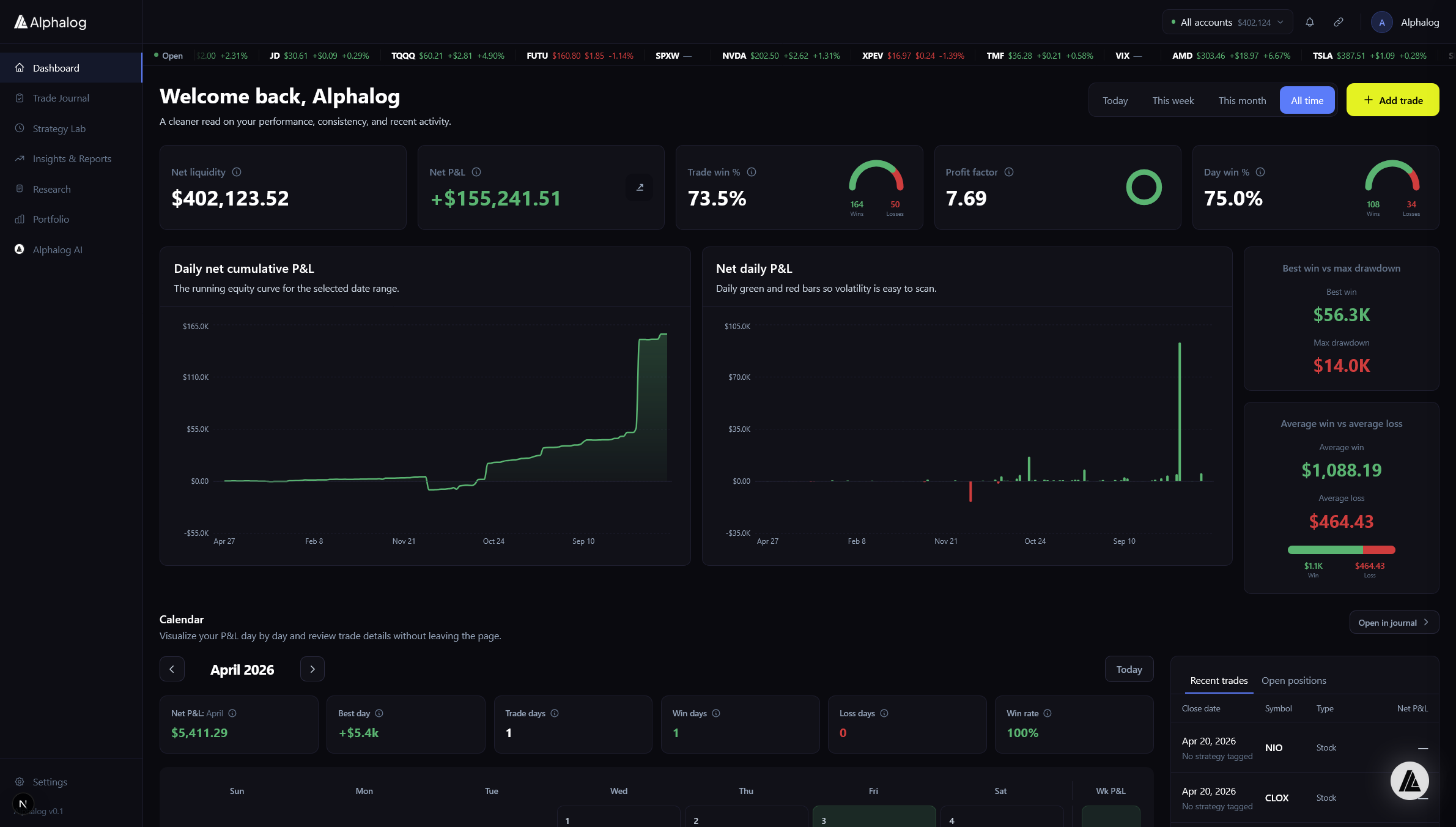
Portfolio Dashboard
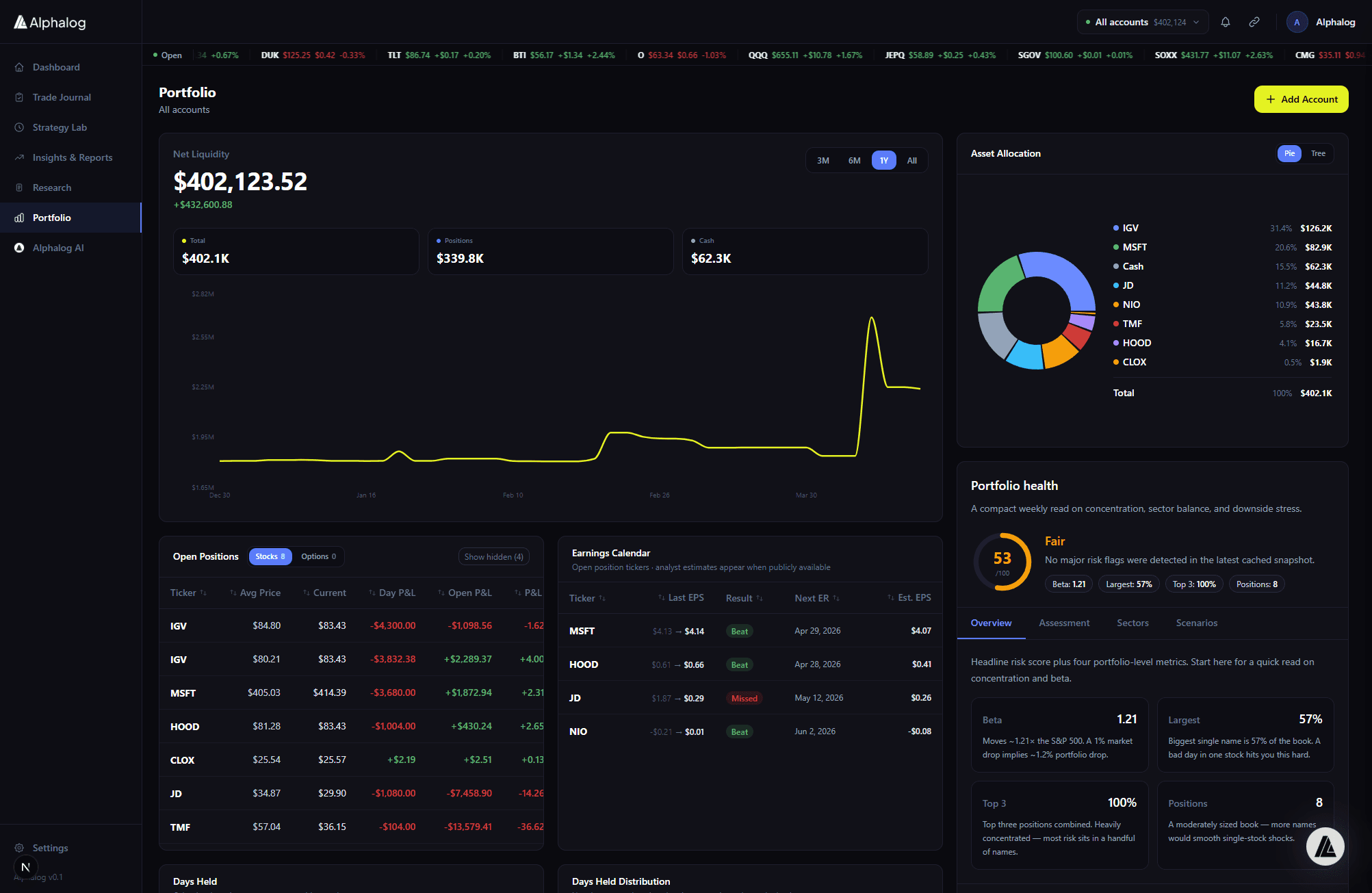
The dashboard aggregates multi-account portfolio data into a unified net worth view with interactive charts, position breakdowns, and real-time performance tracking. A key design challenge was presenting data from 28+ different brokerage APIs in a consistent, scannable format.
The solution uses a card-based layout with progressive disclosure — summary metrics at the top, with drill-down into individual accounts and positions.
Trade Journal
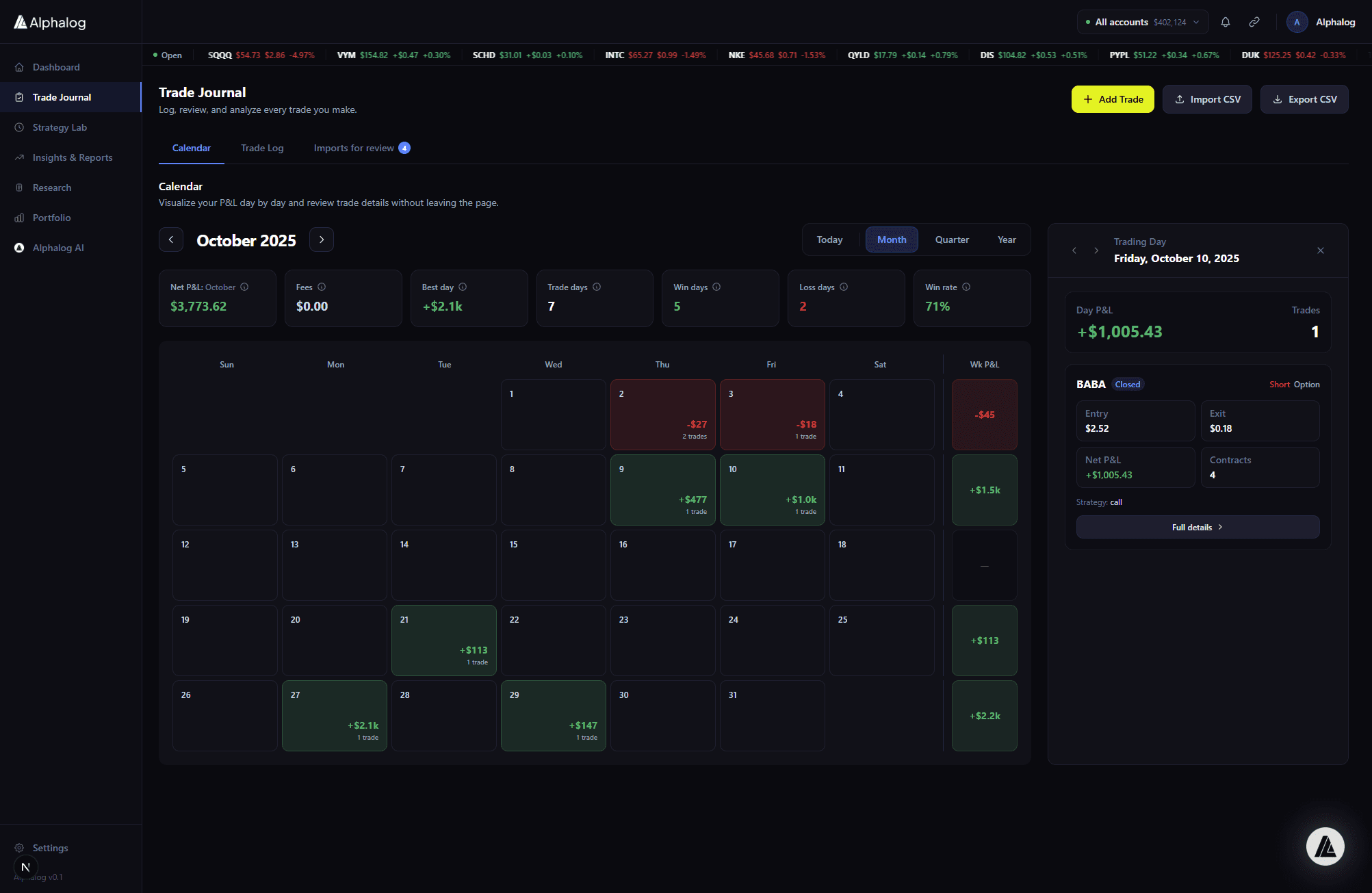
The trade journal is the core of AlphaLog. Unlike spreadsheet-based journals, it automatically imports trades from connected brokerages and supports complex multi-leg options strategies — verticals, iron condors, straddles — without manual data entry.
Each trade entry captures quantitative data (entry, exit, P&L) alongside qualitative context: the trader's thesis, emotional state, and market conditions. This combination is what powers the AI features downstream.
AI Trade Audit
The AI Trade Audit is AlphaLog's signature feature. After a trade is closed, the AI analyzes the full context — entry timing, position sizing, market conditions, the trader's stated thesis, and journal notes — to detect behavioral biases.
The audit identifies patterns like FOMO, revenge trading, overconfidence bias, anchoring, and loss aversion. Rather than simply flagging issues, it explains the reasoning and suggests specific behavioral adjustments.
Design Principles for AI Feedback
- Explanatory, not judgmental — every bias detection includes the AI's reasoning chain
- Actionable suggestions paired with each finding
- Confidence indicators so traders understand the AI's certainty level
- Pattern tracking over time to show behavioral improvement
Strategy Lab
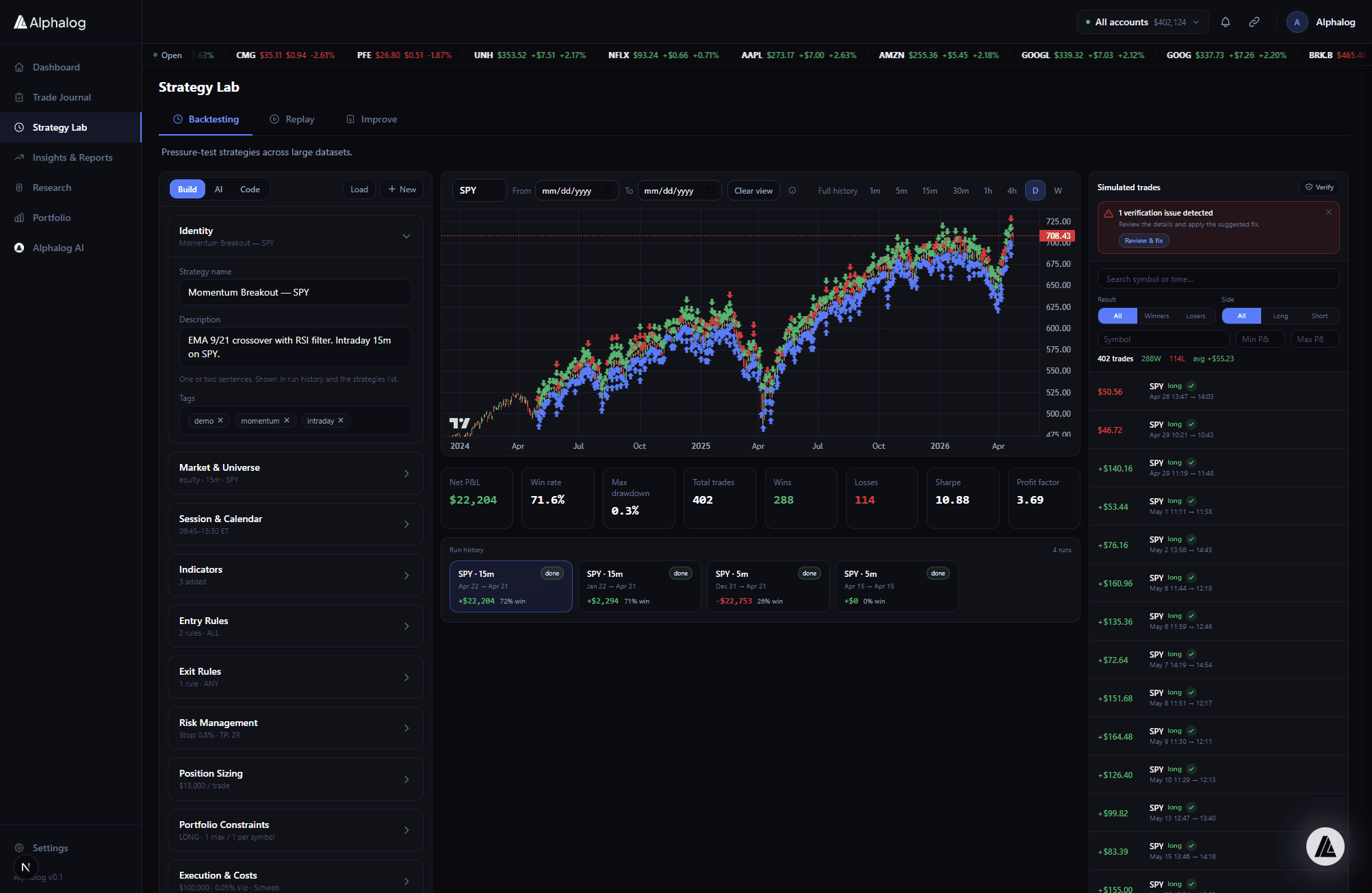
Strategy Lab lets traders describe strategies in natural language — “Buy when RSI drops below 30 and MACD crosses above signal line” — and converts them into backtestable logic. The AI handles the translation from human intent to programmatic strategy.
Backtesting results are presented with clear visualizations: equity curves, drawdown charts, win rate, and risk-adjusted returns. The design prioritizes making statistical results accessible to traders who aren't quants.
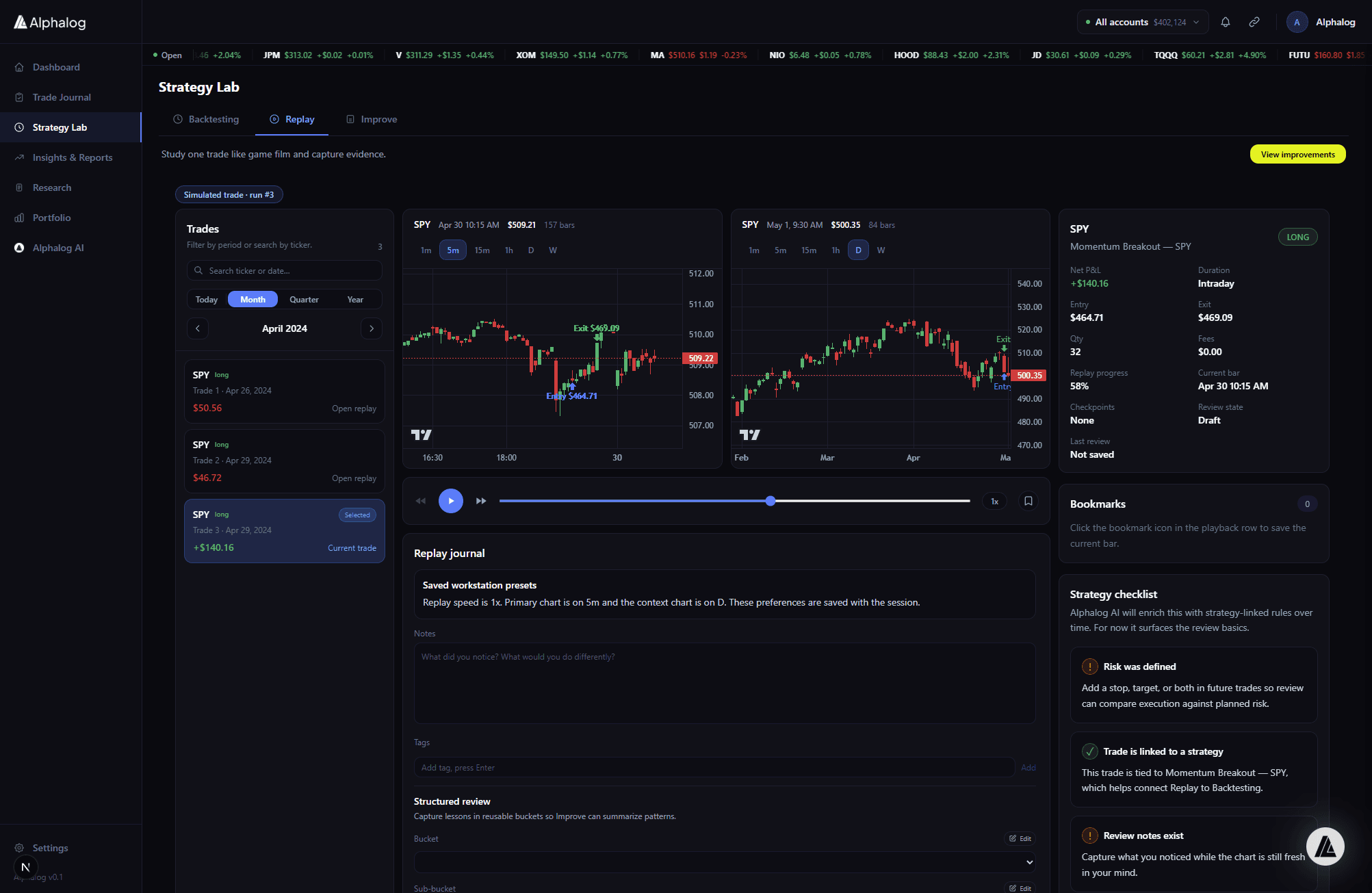
Trade Replays
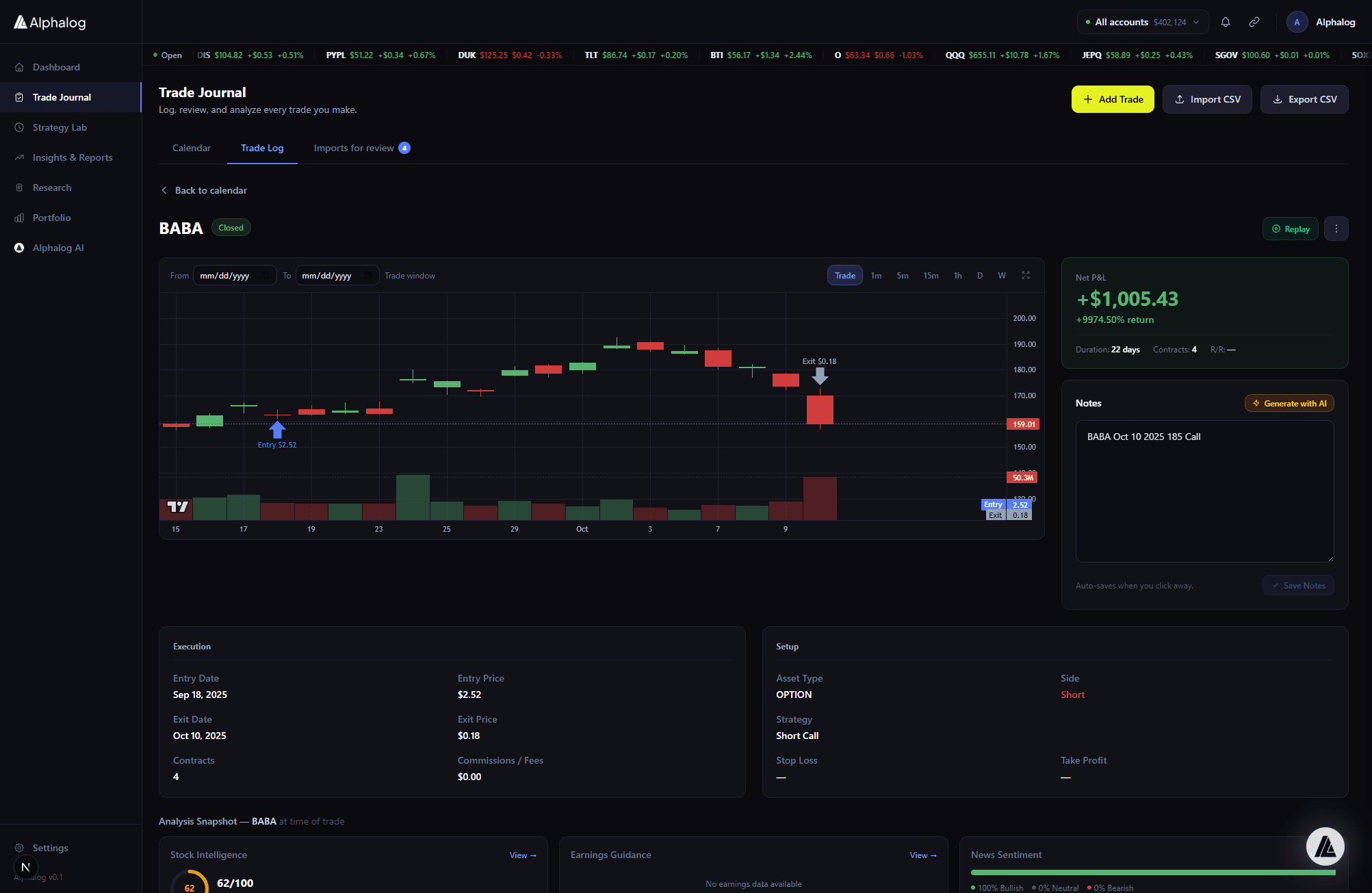
Trade Replays let traders review closed trades bar by bar, re-experiencing the price action as it unfolded. Combined with journal notes and the AI audit, replays create a complete learning loop: what happened, what you were thinking, and what the AI observed about your behavior.
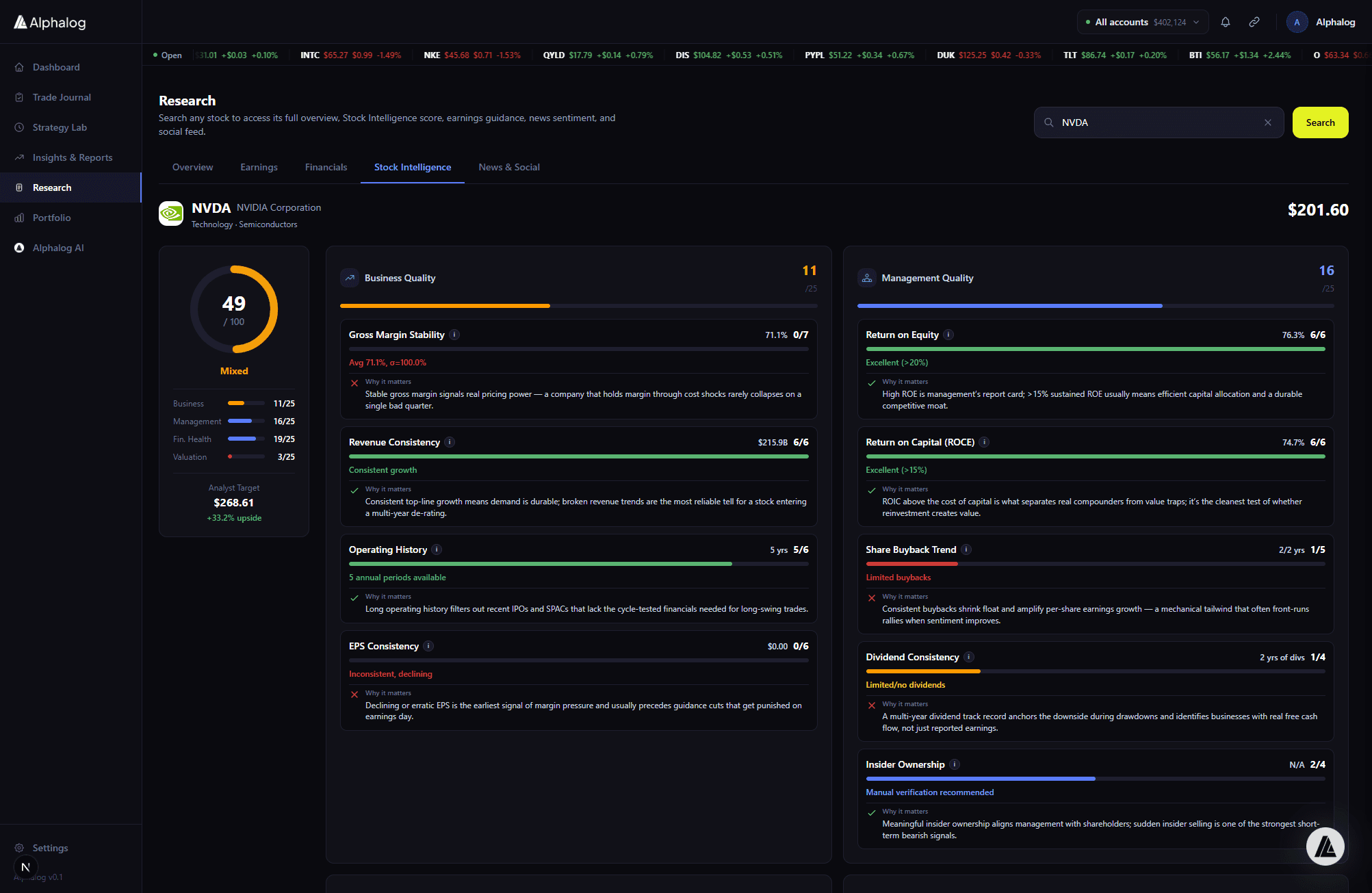
Research Suite
The Research Suite provides institutional-quality analysis tools for retail traders. The centerpiece is a 100-point Stock Intelligence scorecard that evaluates stocks across four pillars — Business Quality, Financial Strength, Earnings Quality, and Valuation — combining fundamental analysis with sentiment data and earnings tracking.
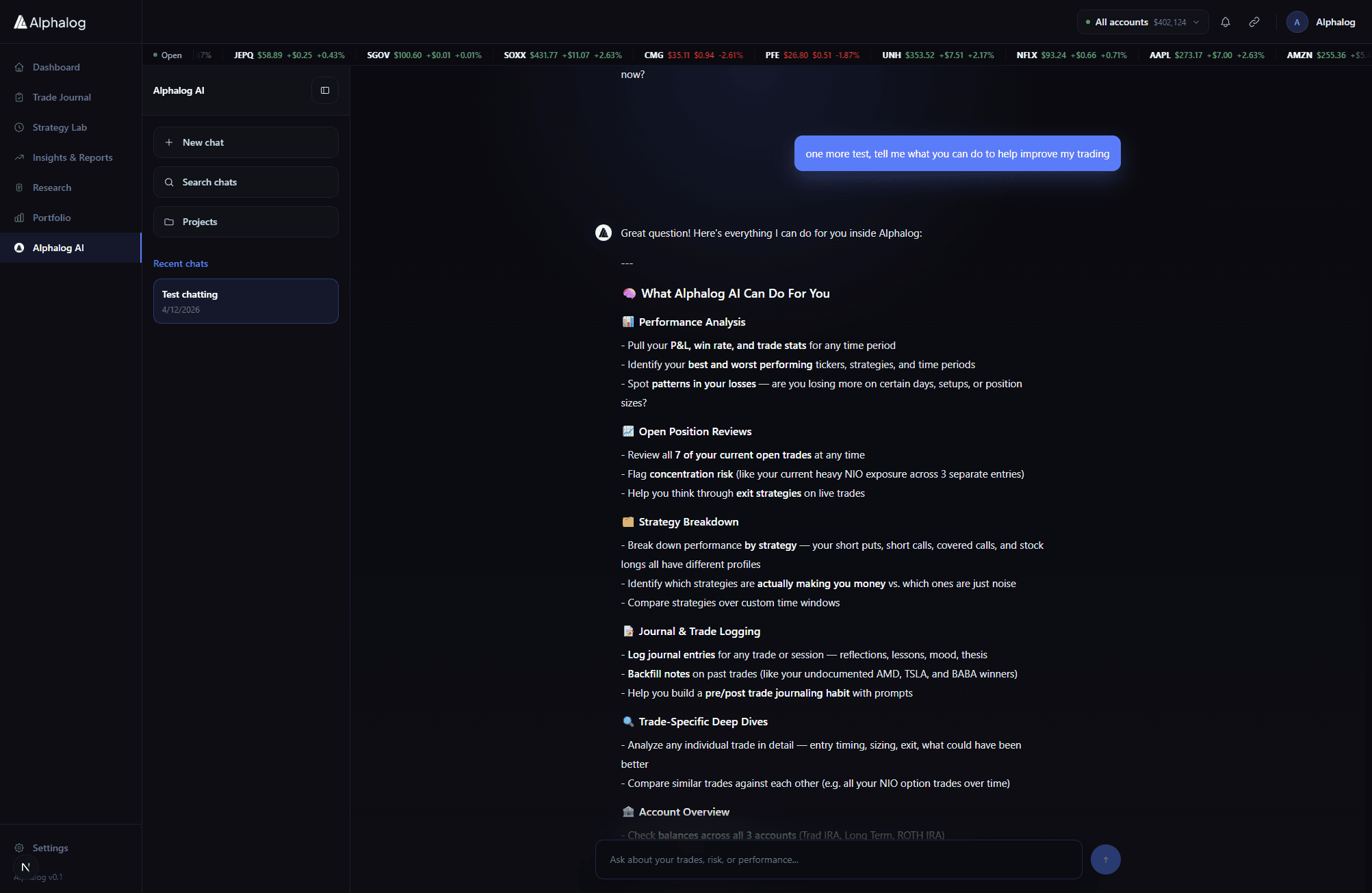
AlphaLog AI
The AI assistant is journal-aware — it has full context of the trader's history, positions, performance, and behavioral patterns. Traders can ask questions like “What's my win rate on earnings plays this quarter?” or “Which of my biases has improved most?” and get answers grounded in their own data.
The assistant also integrates through MCP (Model Context Protocol), allowing it to connect with external tools like Claude Desktop and Cursor while maintaining the journal context that makes its responses uniquely valuable.
Technical Architecture
AlphaLog is built as a monorepo with a modern AI-native stack. The architecture was designed for a solo founder to move fast without sacrificing production quality.
Frontend
Next.js with React, TypeScript, and Tailwind CSS. Server components for performance, client components for interactivity.
Backend & Data
Supabase for authentication, database, real-time subscriptions, and storage. Row-level security for multi-tenant data isolation.
AI & Integrations
Claude for bias detection and strategy translation. SnapTrade for brokerage connectivity. MCP for extensible AI tool integration.
Design System
AlphaLog's design system uses a dark-first approach optimized for extended screen time — traders often monitor positions for hours. The color palette uses high-contrast accents for actionable elements, muted tones for dense data, and semantic colors for P&L (green/red) that remain accessible in both light and dark modes.
The component library is built with Tailwind CSS's design token system, enabling rapid iteration while maintaining visual consistency. Components were designed for data density — financial interfaces require more information per screen than typical consumer apps.
Key Solutions to Design Challenges
Multi-Leg Options Made Simple
A visual grouping system that nests individual legs under their parent strategy, with collapsible detail views. Traders see the strategy-level P&L at a glance and can expand to inspect individual legs. Color-coded leg types provide instant visual parsing.
AI Insights Without Judgment
The AI Trade Audit uses a coaching tone rather than a grading system. Each finding includes the AI's reasoning, a confidence level, and a specific suggestion. Findings are presented as a conversation, not a report card, reducing defensiveness and increasing engagement with the feedback.
Natural Language Strategy Expression
Strategy Lab uses a progressive disclosure pattern: the natural language input is the primary interface, with an advanced mode showing the generated logic for verification. Auto-complete suggestions help traders articulate conditions precisely, bridging the gap between trading intuition and programmatic logic.
Unified Multi-Brokerage Dashboard
A normalization layer maps disparate brokerage data formats into a consistent internal schema. The dashboard uses a card-per-account layout with a unified portfolio summary at the top, letting traders see both the forest and the trees without context-switching between platforms.
Lessons Learned
Building AlphaLog as a solo founder with AI tools has fundamentally changed how I think about the design-development boundary. AI doesn't replace design thinking — it amplifies it. The speed gains from AI pair programming and research synthesis freed me to spend more time on the problems that matter most: understanding user psychology, designing information hierarchy, and crafting interaction patterns that reduce cognitive load.
What Worked
- AI pair programming enabled solo founder velocity across a complex full-stack codebase
- Starting with the journal as the core and layering AI features on top created a natural data flywheel
- Dark-first design system reduced decision fatigue and kept focus on dense financial data
- MCP integration future-proofed the AI assistant for extensibility
What I'd Do Differently
- Start user testing earlier — even with a beta mindset, I designed too long before validating
- Build the design system tokens first, not after — retrofitting tokens slowed iteration
- Scope the MVP more aggressively — six AI features at launch is ambitious for a solo founder
- Invest in automated screenshot testing for the many data-dense views